Chasing a -O2 pessimization in antcc
2026 Oct 12 — c compilers optimization antcc
Recently I was benchmarking the generated code efficiency for my C compiler antcc, and I noticed something concerning in a simple Lua benchmark:
benchmark    opt       runtime
 lua                    1.048s
 lua         -O1        1.077s
 lua         -O2        1.410s
The "optimized" builds were actually slower. Now, my compiler doesn't implement many optimizations at the moment so I wouldn't expect a huge improvement, but being 1.4x slower should definitely not happen.[1] One of the optimizations that antcc does have is inlining, which generally speaking is one of the most impactful compiler optimizations and it usually improves benchmarks all around.
Inlining?
So my first thought was, okay my inlining heuristics and thresholds are very simple and not really tuned, so perhaps it's being too aggressive and blowing up the code size, leading to very bad instruction cache thrashing. If I disabled inlining, the pessimization seemed to go away, which could support that theory. That's not a very satisfactory explanation though, and I would like to fix it, so I looked into it more.
The main culprit was in the function luaV_execute, whose code blew up to
~43KB with -O2, ~2.4x bigger than the -O1 build. Now, this function
is the main bytecode interpreter loop for the Lua VM, and these are one of the
worst kinds of functions for a compiler to deal with: it's a huge function with
a hot loop, many cases/control flow branches, distinct hot/cold paths nested in
the graph where a wrong optimizer or register-allocation decision can pessimize
the whole loop, etc...[2] So the baseline function is a tricky one, but it
doesn't explain this.
Tweaking the inlining thresholds didn't seem to help: either few things got
inlined (like -O1) and binary size & performance stayed roughly the same, or
small functions start getting inlined and the pessimization happens. In
particular, these functions were getting inlined (some in multiple instances):
floatforloop, lessequalothers, lessthanothers, luaV_idiv, luaV_mod,
luaV_modf, luaV_shiftl, luaV_tointegerns, plus some of their respective
callees. In the Lua source code link above you can see those are all pretty
small simple functions.
Looking at the final codegen is not that helpful, but examining the IR[3] revealed something interesting: after all optimizations, the -O2 IR was only 11% bigger than -O1. How could that be amplified to a 2.4x difference in the binary?
Code generation?
The final passes that run after optimizations and before code generation are instruction selection and register allocation. Instruction selection mostly concerns itself with ensuring instruction operands are ready to be lowered into machine code, but keeps temporaries as virtual registers. For example, for x86-64, it models memory operands and will turn a sequence of IR instructions like:
;; int *ptr, res;
i64 %t2 = shl %index, 2
ptr %t3 = add %ptr, %t2
;; res = ptr[index]
i32 %res = loads32 %t3
into
i32 %res = loads32 addr [%ptr + %index * 4]It does other things like introducing register constraints for certain operations, but anyway because it only expands into small sequences of instructions like this, it couldn't be the cause.
Register allocation
Register allocation is the process of mapping virtual temporaries to the target architecture's physical registers. For the previous snippet, that might result in
i32 RAX = loads32 addr [RSI + RDX * 4]which is compiled to the x86 instruction mov eax, DWORD PTR [rsi + rdx * 4].
The problem is that there are infinite virtual temporaries but a small number of registers, so you have to choose which variables get which registers and when there are not enough registers for all of them, some of them have to go on the stack, which is called spilling.
Most operations require values to be in registers, so spilled variables often have to be moved back and forth between registers. Or even worse, they might have to be moved between two different stack slots in some situations.
antcc has a basic implementation of linear scan regalloc. If there is a lot of register pressure and many temporaries get spilled, potentially a lot of instructions can be created just to shuffle values between stack and registers.
And indeed, comparing relative IR size increase before and after regalloc at -O2, the +11%
difference was turning into +70% blowup after regalloc... looking at the disassembly,
>40% of instructions in luaV_execute were just stack⇄register movs. That's really bad,
something being inlined must be resulting in this dreadful register pressure and spilling,
but it's not obvious what.
So let's examine the pre-regalloc IR:
<< Before regalloc >>
function luaV_execute : void(struct lua_State *, struct CallInfo *)
abi: (RDI, RSI)
   ....
    ptr %4613 = add %0, 56
    ptr %5340 = add %0, 40
    b @2
  @2:   ; preds: @1, @892       ; loop depth: 1
    i64 %4489 = phi @1 undef, @892 %3124
    i64 %3030 = phi @1 undef, @892 %3065
    i64 %4636 = phi @1 undef, @892 %2287
    i64 %4764 = phi @1 undef, @892 %3869
    i64 %2874 = phi @1 undef, @892 %3929
    i64 %2694 = phi @1 undef, @892 %3981
    i64 %4872 = phi @1 undef, @892 %3804
    i64 %2297 = phi @1 undef, @892 %3497
    i64 %5062 = phi @1 undef, @892 %3158
    i64 %2208 = phi @1 undef, @892 %3145
    i64 %2161 = phi @1 undef, @892 %4191
    i64 %5275 = phi @1 undef, @892 %4225
    i64 %5290 = phi @1 undef, @892 %4252
    i64 %1791 = phi @1 undef, @892 %4370
    i64 %3813 = phi @1 undef, @892 %3195
    i64 %3807 = phi @1 undef, @892 %4403
  ....
Oh. That looks strange.
SSA and phis
My compiler like most modern backends uses a Static Single-Assignment representation. In this form, straight-line code such as (I'm using C-like pseudocode to simplify):
x = a + b
x = x + y    # reassigning x
use(x)
Becomes:
x1 = a + b
x2 = x1 + y  # fresh definition
use(x2)
That is, there are no variable mutation instructions. The reason this representation is great for compilers is that it simplifies all kinds of data-flow analysis and permits some more powerful optimizations than the non-SSA counterpart.
With control flow, data flow merges are explicit in the IR:
if (cond) {
    x = a + 1
} else {
    x = b - 1
}
use(x)
In SSA form is represented as:
if (cond) B0: {
    x1 = a + 1
} else B1: {
    x2 = b - 1
}
x3 = phi(B0: x1, B1: x2)
use(x3)
This magic "phi" instruction[4] has as its result the value of x1 or x2 depending on which
control flow branch was taken. Same approach can be applied for variables modified in loops:
i = 0
while (cond) {
    use(i)
    i += 1
}
in SSA:
i0 = 0
Entry: while (cond) {
  LoopBegin:
    i_l = phi(Entry: i0, LoopEnd: i_n)
    use(i_l)
    i_n = i_l + 1
  LoopEnd:
}
Textually, it looks like the phi function references i_n before its definition, but
importantly that value is only taken in the loop back-edge (LoopEnd -> LoopBegin),
and at that point the value of i_n is available.
A key thing to realize here is that this i_l temporary, being a loop phi, is live
across the whole loop, since its value is used to compute the next iteration.
Going back to that IR dump from Lua:
@2:   ; preds: @1, @892       ; loop depth: 1
  i64 %4489 = phi @1 undef, @892 %3124
  i64 %3030 = phi @1 undef, @892 %3065
  ...
Ignore the undefs for now, and notice the ; preds line indicating the
predecessors of that block: @1, the beginning of the function, and @892,
hundreds of blocks later: the end of the main interpreter loop. Meaning, we
have 16 phis that are live across the whole loop. This is what is creating a
lot of register pressure, wrecking register allocation and resulting in that
big code size blowup from stack spilling traffic. So, what are these phis,
where do they come from, and why the undefs...
mem2reg
C programs don't start in SSA form, so they have to go through a transformation pass. I borrowed the terminology and design from clang/LLVM in my compiler:
- Variables always start as virtual stack slots, defined with an
allocapseudo-instruction.[5]- Since local variables in C can have their address taken[6], this
directly models the C abstract machine's definition of
automatic variables: a physical addressable stack slot that can be read from or written to.
- Since local variables in C can have their address taken[6], this
directly models the C abstract machine's definition of
- Variable reads turn into memory
loadinstructions, and writes turn intostoreinstructions. - Later, the
mem2regpass collects stackallocas whose address does not escape (meaning they are only used for direct reads and writes that the compiler can observe), and "promotes" them into SSA temporaries, inserting phi instructions where necessary.
So C code like:
int x;
x = foo();
...
if (x < 0) { x = -x; }
return x;
Initially generates an IR that looks like:
@1:
  ptr %x = alloca 4 bytes
  i32 %t1 = call foo()
  store i32 %x, %t1
  ...
  i32 %t2 = load i32 %x
  bool %cond = lth %t2, 0
  br %cond, true -> @2, false -> @3
@2:
  i32 %t3 = load i32 %x
  i32 %t4 = neg %t3
  store i32 %x, %t4
  b @3
@3:
  i32 %t5 = load i32 %x
  ret %t5
And mem2reg turns it to:
@1:
  i32 %x1 = call foo()
  ...
  bool %cond = lth %x1, 0
  br %cond, true -> @2, false -> @3
@2:
  i32 %x2 = neg %x1
  b @3
@3:
  i32 %x3 = phi @1 %x1, @2 %x2
  ret %x3
I'm glossing over the trickiest part of this, which is knowing when and where to insert these phi instructions in the general case. There's basically two algorithms to do it, and the one I'm using is from the paper "Simple and Efficient Construction of SSA Form (Braun et al, 2013)". The gist of it is: walk the control-flow graph (CFG) in reverse post-order (RPO); when you see a write, memoize the current definition keyed by the block; when you see a read, look for that definition or query the predecessors' definitions recursively and insert phis when that lookup finds distinct definitions. Loops are trickier: because the back-edge predecessors haven't been visited yet, you have to insert a provisional phi and resolve it later.
Something about C that almost every language that came after it removed as a Bad Idea is the ability to leave variables uninitialized. For example:
int x;
if (foo()) {
    int y = bar();
    x = y;
}
use(x);
After the control flow merge, x is phi(uninitialized, y). That is what
the undef in my IR is. The way it's introduced in my mem2reg is that if the
recursive "read current definition" function reaches all the way to the
beginning of the function without finding a definition, it gives it undef.
(Later on, moves and operations on undef can be effectively optimized away.)
How this showed up in Lua
So was the Lua interpreter reading uninitialized variables? Well, no. Look at some of the affected code from the interpreter function:
  vmcase(OP_SHRI) {
    TValue *rb = vRB(i);
    int ic = GETARG_sC(i);
    lua_Integer ib;
    if (tointegerns(rb, &ib)) {
      pc++; setivalue(s2v(ra), luaV_shiftl(ib, -ic));
    }
    vmbreak;
  }
  // several other instructions follow that same template
The key is the tointegerns macro, which in turn calls the function luaV_tointegerns:
int luaV_tointegerns (const TValue *obj, lua_Integer *p, F2Imod mode) {
  if (ttisfloat(obj))
    return luaV_flttointeger(fltvalue(obj), p, mode); // <- this gets inlined
  else if (ttisinteger(obj)) {
    *p = ivalue(obj);
    return 1;
  }
  else
    return 0;
}
In -O2, this function and luaV_flttointeger get inlined, resulting in an
expansion like this (simplified):
  vmcase(OP_SHRI) {
    ...
    lua_Integer ib;   // <--- declaration
    int tointegerns_ret;
    if (ttisinteger(rb)) {
      ib = ivalue(rb);   // <--- write
      tointegerns_ret = 1;
    } else if (ttisfloat(rb)) {
      ...
      ib = (lua_Integer)fvalue(f);    // <--- write
      tointegerns_ret = 1;
    } else {
      tointegerns_ret = 0;
    }
    if (tointegerns_ret) {
      ... (use ib)
    }
    vmbreak;
  }
mem2reg is always ran after every inlining pass. The undef in question
comes from the variable ib which I've marked. You can see that the local
variable is initialized in every path where the inlined function returns 1,
but mem2reg cannot correlate that with the later if (tointegerns_ret) guard,
so it sees a possibly uninitialized read.
But that does not tell the whole story! It explains the undef, but not why
the phi is live across the whole loop. After all, this local is scoped to a
block inside a branch of the loop, it does not live across loop iterations...
The problem
Eventually I figured out the root cause: I was treating the idea of "variables
start as uninitialized" too literally in mem2reg. When it encountered an
alloca, it didn't give it a definition for the current block. This sounds
correct, and the recursive lookup in the algorithm terminates at the function
entry with an undef. But recall the catch with loops being that when you
encounter a backedge, you don't know if there's a later definition, because you
haven't visited the whole loop yet, so you insert a provisional phi...
In essence, my mem2reg was behaving as if code like:
int foo() {
  while (...) {
    int x;
    if (...) {
      x = bar();
    }
    use(x);
  }
}
was actually
int foo() {
  int x;
  while (...) {
    if (...) {
      x = bar();
    }
    use(x);
  }
}
In the 2nd function, the value of x is kept across iterations, whereas in the
1st, the value of x is a 'fresh' uninitialized every time the if branch is
not taken... This is not a miscompilation: as far as C is concerned, this is
fine because uninitialized variables' values are not legally usable anyway. And
if you frame it in terms of stack-allocated variables, it's a sensible
approach: the slot for x is fixed for the whole function and doesn't get
reset between loop iterations, so it keeps the previous iteration's whatever
it was and it doesn't matter. But the problem is that in the context of SSA
form, this generates something like:
while (...) {
  %x = phi(undef, %x2)
  if (...) {
    %x1 = bar();
  }
  %x2 = phi(%x, %x1)
  use(%x2);
}
And it is these loop phis that result in the pathological register allocation. The fix was one line:
--- a/src/ir_mem2reg.c
+++ b/src/ir_mem2reg.c
@@ -244,6 +244,8 @@ mem2reg(Function *fn) {
             v->cls = k;
             v->i = var;
             sb.vars[var] = v;
+            v->curdefs[blk->id] = UNDREF;
          } else {
             sb.vars[var] = DEAD;
          }
Initializing the var as undefined (a nice oxymoron) at the place of the
alloca ensures that the recursive lookup doesn't cross loop backedges and
insert phis in the loop header. This is enough to fix this case, and that
change made the mysterious pessimization disappear.
Closing notes
This problem can still bite for C code that is old-style declaring all variables at the top of the function. It's possible to fix this general case by using Tarjan's algorithm to find the graph SCCs of the phi data-flow to detect cycles, and making use of these undef semantics when classifying phis as redundant; but I haven't implemented that yet.
Jump threading an inlined function used directly as a branch condition, or more
generally SSA-aware phi jump threading, could've also fixed the branch
correlation issue that led to mem2reg not seeing the dominating write of
those variables and introducing undefs.
I made use of AI agents to help debug this issue. It saved me a lot of time in investigating, filtering through disassemblies and IR dumps, running the compiler with different inlining thresholds and measuring, etc; but it was not good at trying to find the root cause. It proposed probably around 10 convoluted "fixes" before I eventually arrived at the conclusion myself. Still <$1 well spent for the sake of reducing tedium.
Benchmarks
Lua 5.4.7, bench.lua, AMD Ryzen 5 5600G. Take these with a grain of salt.
Pre-fix:
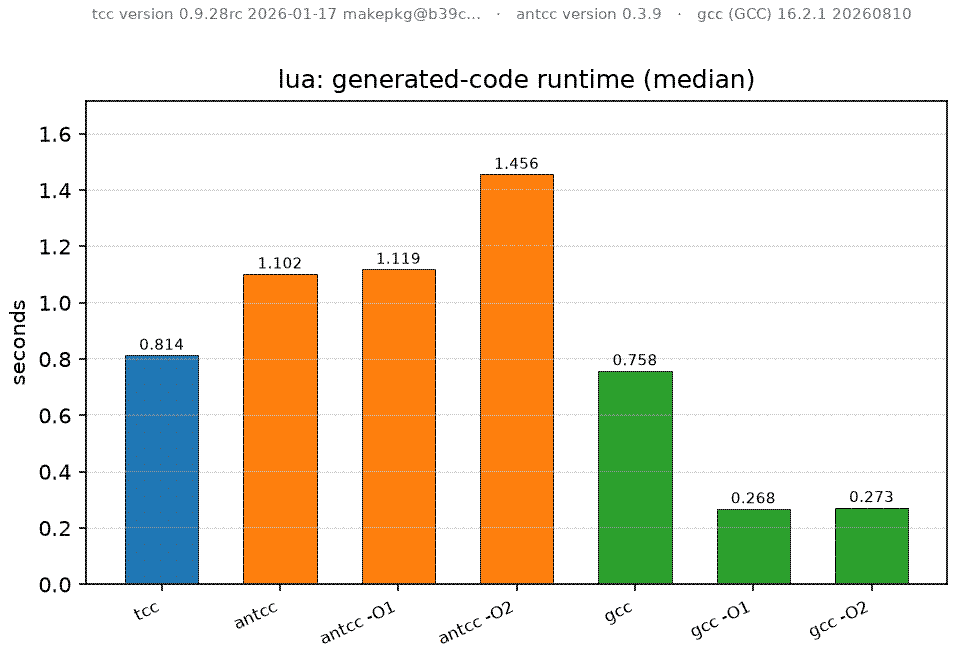
antcc was worse than even tcc, but that's mainly because my frontend was lowering switch statements to linear if-else chains. I implemented a simple binary search codegen, which was one of those things that I just hadn't gotten around to yet; and a few other minor optimizations; after this fix.
Current numbers:
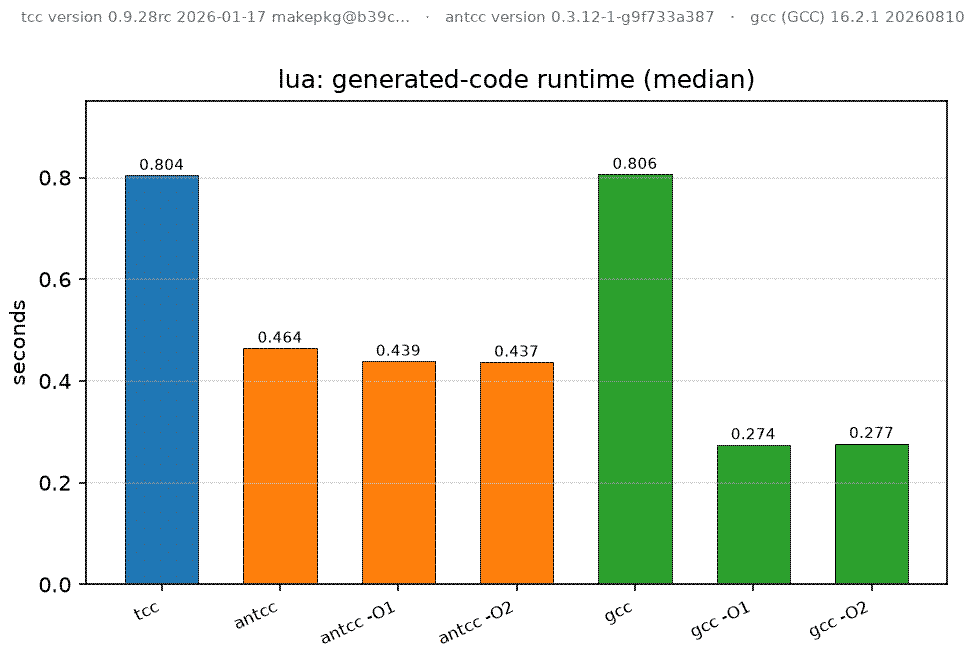
Do note that antcc performs mem2reg by default when passed no optimization
flags, unlike gcc. It might seem counterintuitive, but from my testing, running
mem2reg improves compile times too; presumably due to the reduced number of
stack store/load instructions for the backend to churn through.
And compile times:
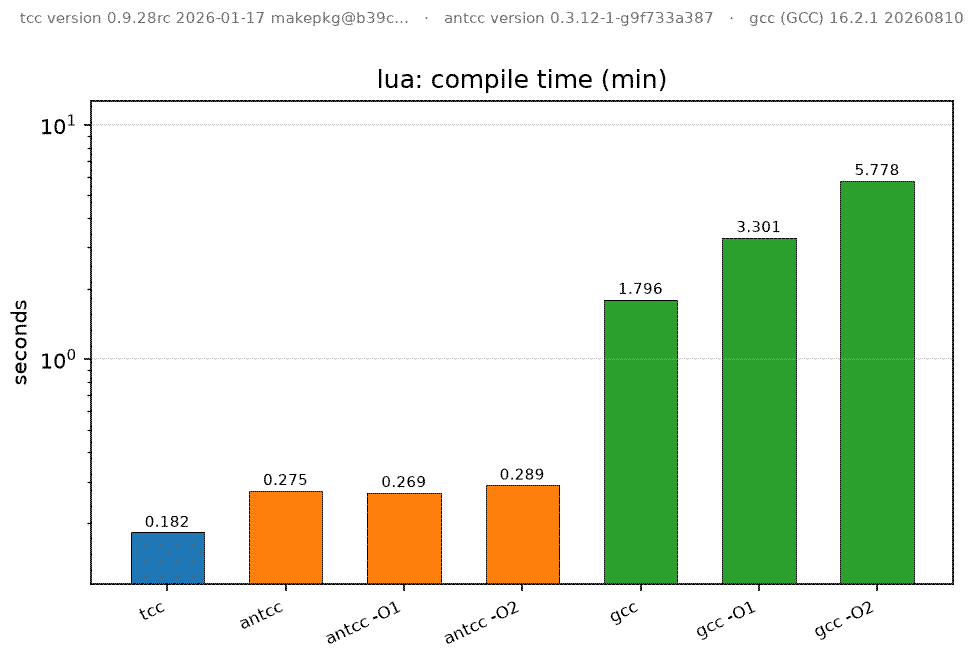
I omitted the bars for clang because they are all very similar to gcc.
-
The only difference between -O1 and -O2 is in inlining thresholds and -O2 running some optimization passes more than once. ↩
-
This is why LuaJIT's interpreter in hand-written assembly beats almost every other bytecode interpreter, and it's not just about the while-switch loop ↩
-
Intermediate representation ↩
-
variously known as phi function, φ, /faɪ/, /fi/, phony instruction ↩
-
Not to be confused with the dynamic
alloca()function. ↩ -
The
registerstorage class exists, but it doesn't really matter in modern architectures so you (almost) never see it used. ↩